
Exercise Performance
Performance Begins Before Movement.
For decades, sports nutrition has focused on what happens during exercise—protein intake, carbohydrate replenishment, hydration, and training intensity. While these remain essential, they represent only part of the performance equation.
Today, researchers are taking a broader view. Exercise performance is increasingly understood as the result of multiple interconnected physiological systems working together. How efficiently the body produces energy, utilizes nutrients, adapts to training, and recovers after exercise may ultimately determine athletic performance as much as muscle strength itself.
Among these emerging areas of research, the gut microbiome has become one of the most promising frontiers.
Why Exercise Performance Is More Than Muscle
Skeletal muscle does not function in isolation. Every movement depends on a continuous supply of energy, efficient nutrient utilization, and the body's ability to recover from physical stress. When any of these processes become less efficient, performance gradually declines—even in healthy, physically active individuals.
Rather than focusing solely on increasing muscle mass or protein intake, sports nutrition is shifting toward optimizing the physiological systems that support muscle function throughout exercise. This broader understanding is reshaping how performance is evaluated and how next-generation nutritional strategies are developed.
The Hidden Barriers to Better Performance
Performance limitations often develop long before athletes notice a measurable decline in strength. Three physiological challenges are commonly associated with reduced exercise capacity:
- Early Fatigue : During prolonged or high-intensity exercise, metabolites such as lactate and ammonia accumulate progressively. As these by-products increase, muscles fatigue more quickly, making it increasingly difficult to maintain performance.
- Slower Recovery : Recovery is a critical component of performance adaptation. Inadequate recovery between training sessions may reduce training frequency, delay physiological adaptation, and ultimately limit long-term performance improvements.
- Reduced Energy Efficiency : Efficient energy metabolism enables muscles to sustain repeated contractions during prolonged exercise. As energy utilization becomes less efficient, endurance capacity decreases and maintaining exercise intensity becomes increasingly challenging.
The Gut–Muscle Axis: A New Perspective on Sports Nutrition
Growing evidence suggests that communication between the gut microbiome and skeletal muscle plays an important role in exercise physiology.
Known as the gut–muscle axis, this biological network links intestinal microorganisms with metabolic processes involved in exercise performance. Through microbial metabolites and nutrient signaling, the gut microbiome may influence how efficiently the body utilizes protein, produces energy, and adapts to physical activity.
This emerging concept is expanding the traditional view of sports nutrition—from supplying nutrients to supporting the body's own physiological capacity for performance and recovery.
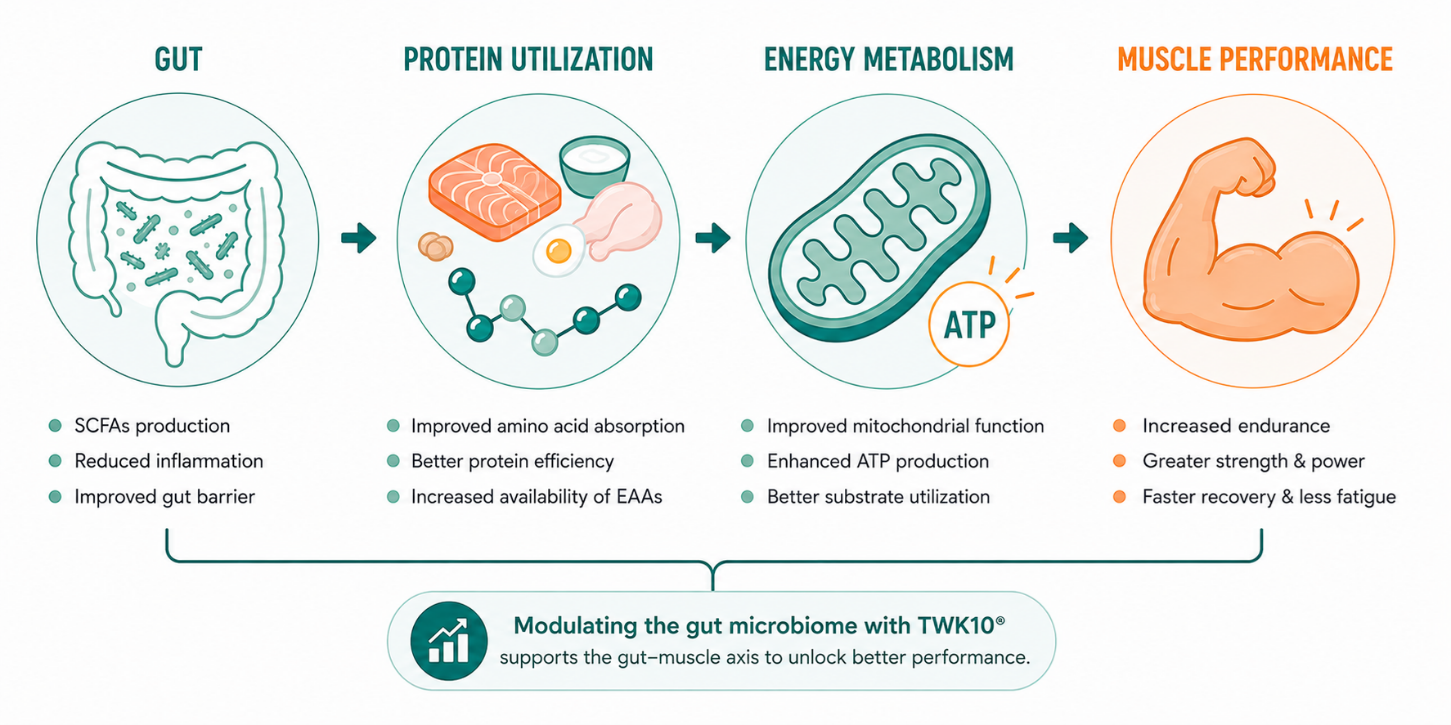
TWK10®: Supporting Performance Through the Gut–Muscle Axis
TWK10® (Lactiplantibacillus plantarum TWK10) is a clinically studied probiotic strain developed to support exercise performance through modulation of the gut microbiome.
Instead of acting directly on skeletal muscle, TWK10® helps support the biological pathways involved in nutrient utilization, energy metabolism, and exercise adaptation. This microbiome-based approach represents a complementary strategy alongside conventional sports nutrition ingredients.
Today, TWK10® is one of the most extensively studied probiotic strains in the field of exercise performance, supported by a growing portfolio of human clinical studies and scientific publications.
Clinical Evidence
TWK10® is one of the most extensively studied probiotic strains for exercise performance, supported by a growing body of human clinical research.
To date, its scientific portfolio includes:
- 27 peer-reviewed publications
- 9 human clinical studies
- 18 patents
Human clinical studies have reported significant improvements in endurance performance, muscle gain, muscle thickness, amino acid absorption, and post-exercise recovery following TWK10® supplementation. Collectively, these findings support the role of microbiome modulation in exercise adaptation.
.png)
Collectively, these findings suggest that supporting the gut microbiome may complement conventional sports nutrition strategies by improving nutrient utilization, metabolic efficiency, and exercise performance.
Looking Beyond Conventional Sports Nutrition
As scientific understanding of the gut microbiome continues to evolve, sports nutrition is moving beyond the traditional focus on protein and energy supplementation alone.
Supporting the biological systems that regulate nutrient utilization, metabolic efficiency, and recovery may become an increasingly important strategy for improving exercise performance.
By targeting the gut–muscle axis, TWK10 represents a science-driven approach that aligns with this evolving understanding of human performance.
Related Articles
- The Gut–Muscle Axis
- Aging & Sarcopenia
- Scientific Evidence
References
- Huang WC, et al. Nutrients. 2016;8:205.
- Huang WC, et al. Chinese Journal of Physiology. 2018;61:163–170.
- Huang WC, et al. Nutrients. 2019;11:2836.
- Lee MC, et al. Food Science & Nutrition. 2020;8:3525–3534.
- Lee MC, et al. Aging Cell. 2024.