
The Gut–Kidney Axis
Protecting the kidney starts in the gut.
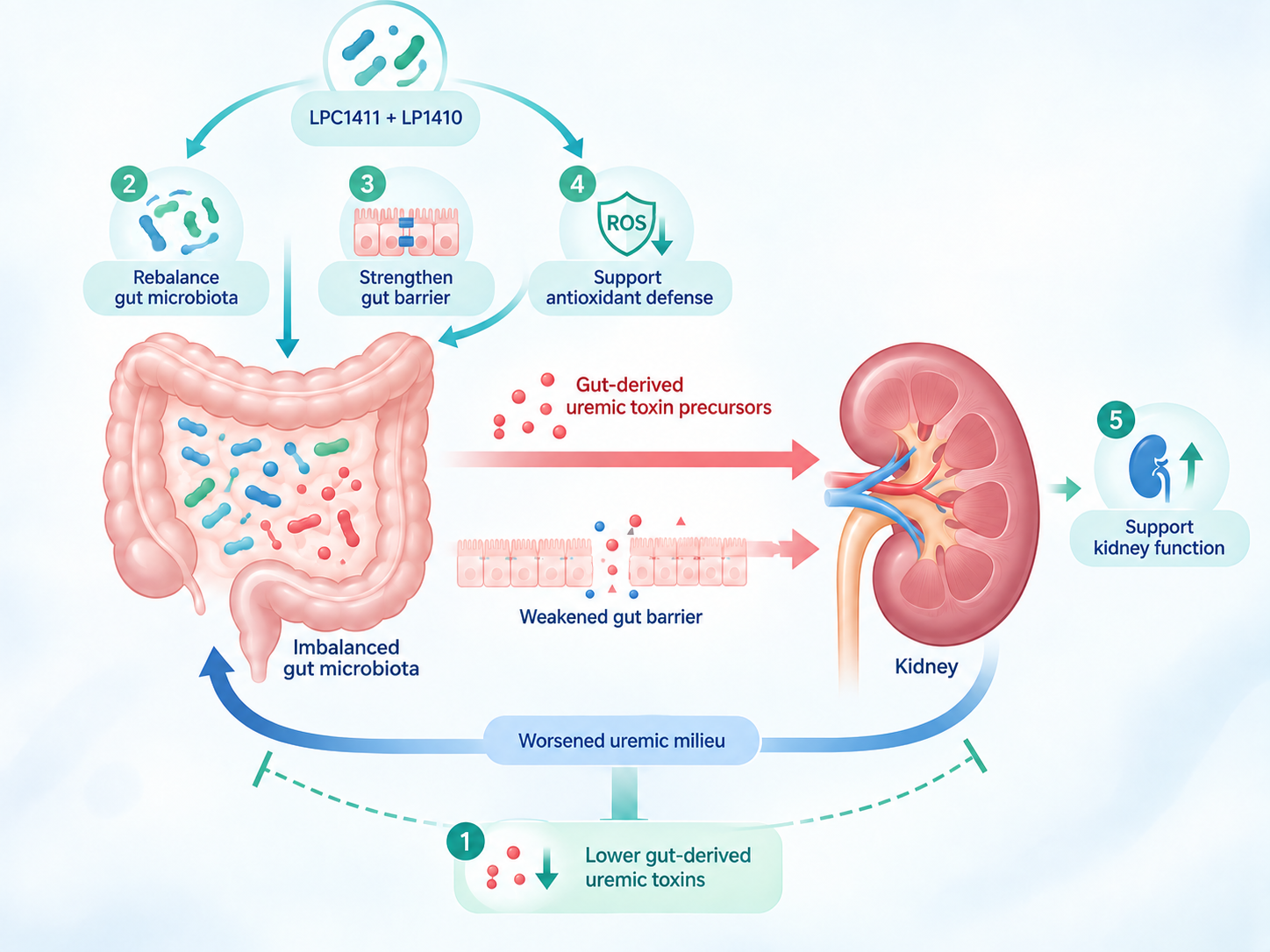
SynForU-ReMain is a two-strain probiotic formula for kidney health. Its benefits do not come from a single action. In chronic kidney decline the gut and kidney form a damaging loop: a disrupted gut microbiota produces more toxins, a weakened gut barrier lets those toxins into the blood, and the kidney, less able to clear them, suffers further oxidative and inflammatory injury. SynForU-ReMain works along this gut–kidney axis to interrupt the loop from the gut side.
1. Lowering gut-derived uremic toxins
Much of the toxic burden in kidney decline begins in the gut. Gut bacteria turn dietary protein into indole and p-cresol, which the body converts into the uremic toxins indoxyl sulfate and p-cresyl sulfate, both of which are implicated in kidney dysfunction and disease progression. SynForU-ReMain’s strains were selected for their ability to bind and reduce these precursors, and in a preclinical CKD (mouse) model the two-strain mixture reduced circulating indoxyl sulfate by 26.2% and p-cresyl sulfate by 19.0%.
2. Rebalancing the gut microbiota
Kidney decline is accompanied by gut dysbiosis, a loss of beneficial, short-chain-fatty-acid-producing bacteria. In the same model SynForU-ReMain restored microbial diversity and replenished beneficial genera that correlated with lower toxin levels and better kidney markers. Cross-species work in cats, using multi-omics, showed the two strains engraft in the gut, raise diversity, and suppress harmful Escherichia/Shigella.
3. Strengthening the gut barrier
A healthy gut barrier helps limit the movement of gut-derived compounds into the bloodstream. In the preclinical CKD model, the two-strain mixture was associated with improved intestinal barrier integrity and reduced gut permeability by 26.8%, limiting the leakage of bacterial products and toxins into circulation.
4. Restoring antioxidant defense
Gut-derived uremic toxins are associated with oxidative stress in kidney decline. In the preclinical model, the two-strain mixture was associated with higher antioxidant-enzyme activity, with catalase increasing by 32 to 40% and glutathione peroxidase by 19 to 21%, alongside lower markers of kidney inflammation and fibrosis.
5. Supporting kidney function
Reducing toxin burden, oxidative stress, and inflammation translates into functional support. In the preclinical CKD model these changes were accompanied by lower BUN and creatinine and less kidney fibrosis; in a human pilot in kidney-transplant recipients with stable grafts, three months of the two-strain formula was associated with a small but statistically significant improvement in kidney-function markers (serum creatinine down about 5.0% and eGFR up about 5.2%).
Balance, from more than one direction
No single mechanism tells the whole story. What sets SynForU-ReMain apart is that it addresses kidney health at its gut-based source: toxins, dysbiosis, barrier integrity, and oxidative stress together, rather than any single pathway.
Want the full mechanistic and clinical dossier? Contact Us!
References
- Huang H, et al. J Agric Food Chem. 2021;69(26):7353-7366. DOI: 10.1021/acs.jafc.1c01547
- Chan W-N, et al. Transplant Proc. 2023;55(9):2090-2094. DOI: 10.1016/j.transproceed.2023.08.011
- Huang H-W, et al. Front Vet Sci. 2025;12:1590388. DOI: 10.3389/fvets.2025.1590388
This page is for B2B communication and education. Local regulations vary by country; customers are responsible for compliance before marketing or making health-related claims.